
 Real Estate
Should Thane Homebuyers Also Consider Commercial Investment?
Table of Contents
If you’ve already bought or are planning to buy a home in Thane, you’ve probably noticed how much the city has changed in the last few years — better connectivity, more established townships, and a growing corporate presence. That same growth is now creating opportunities beyond residential property. Here’s why more of our clients are asking us about commercial investment in Thane alongside their home purchase.
Why Residential Buyers Are Looking at Commercial Property Too
Most people start their real estate journey with a home purchase — understandably, it’s the more emotional, immediate need. But once that’s settled, many buyers start thinking about building long-term wealth, and that’s where commercial property enters the conversation. Unlike a home, a commercial unit is bought purely as an investment, with rental yield and appreciation as the goal from day one.
What Makes Thane Attractive for Both
The same infrastructure growth that’s made Thane a strong residential market — better roads, upcoming metro lines, established townships like Hiranandani Estate — is exactly what’s now driving commercial demand too. Areas we’ve long recommended for family homes, like the Kolshet and Ghodbunder Road belt, are now also seeing serious commercial development.
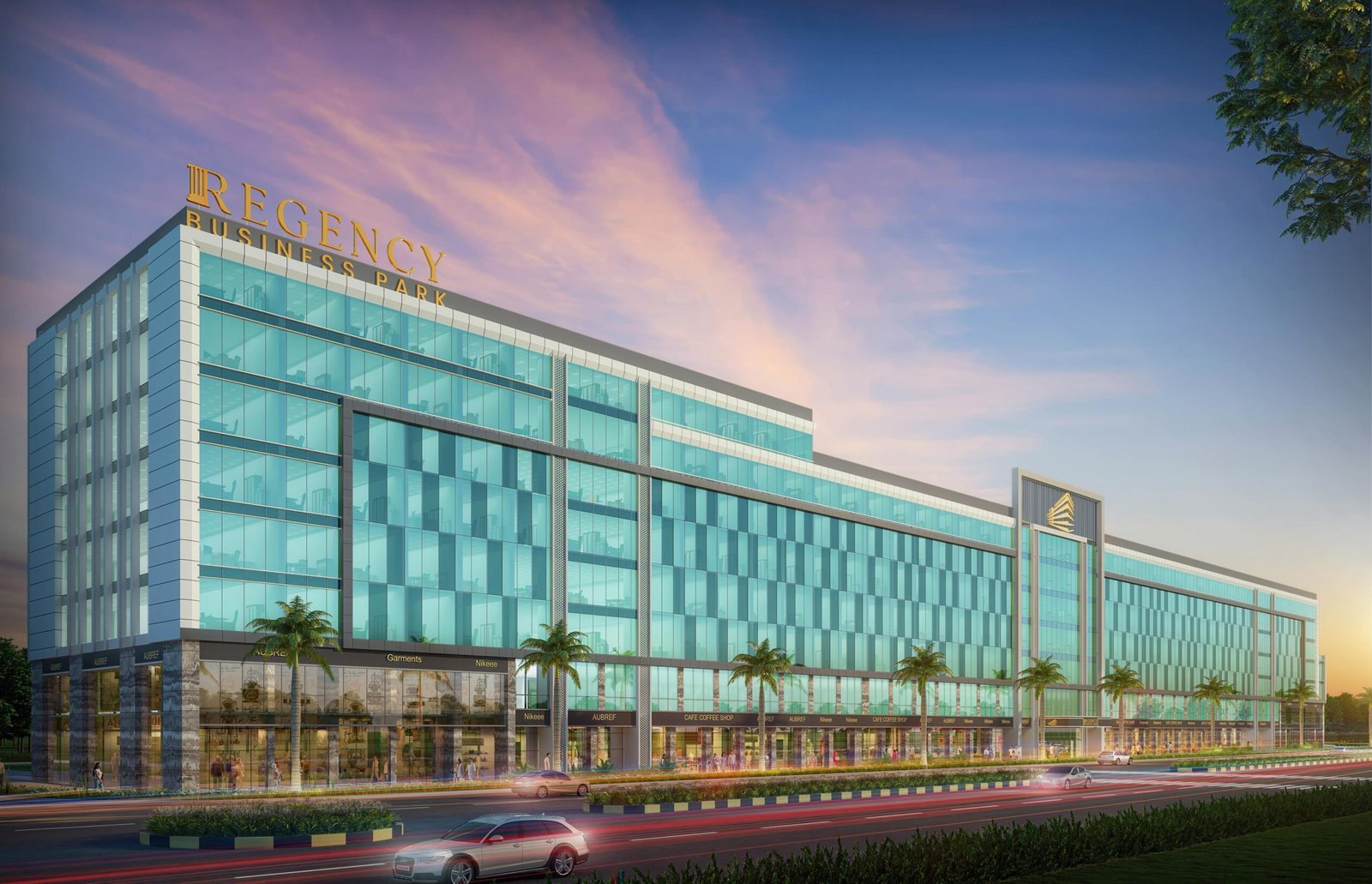
A Commercial Option Worth Knowing About: Regency Business Park
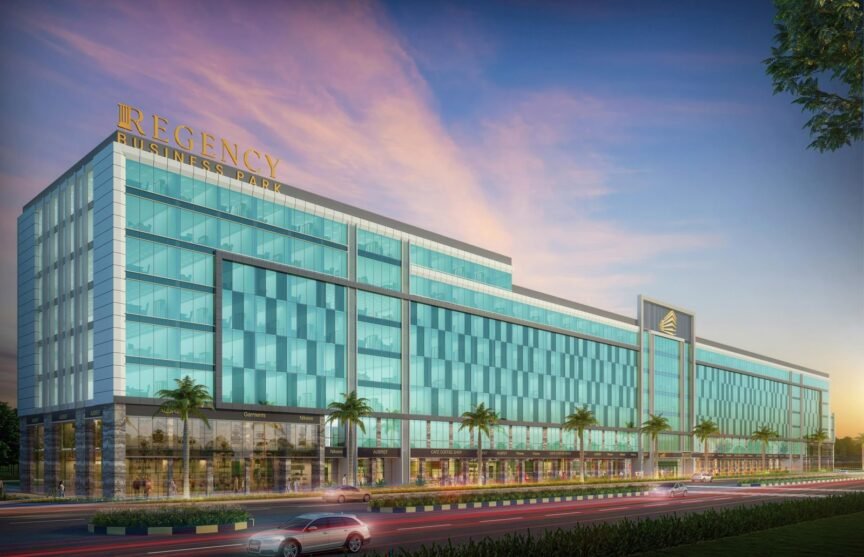
One project currently drawing attention in this space is Regency Business Park, located in Kolshet near Hiranandani Estate — the same corridor where many of our residential clients have already bought homes. It’s developed by Regency Group, offers office and retail units starting from 253 sq. ft., and is RERA registered (MahaRERA P51700053811).
For homebuyers who already know and trust this locality from their own residential search, a commercial unit here can be an easier “next step” investment than exploring an entirely unfamiliar area.
Key Things to Understand Before Moving from Residential to Commercial
- Different tax treatment — commercial property purchases attract GST (typically 12% if under construction), unlike most residential resale transactions. Factor this into your budget from the start.
- No stamp duty concession — the women’s stamp duty benefit that applies to residential property in Maharashtra does not extend to commercial purchases.
- Income-focused, not lifestyle-focused — a commercial purchase should be evaluated purely on rental yield and appreciation potential, not on how it “feels,” which is a different mindset shift for many first-time commercial buyers.
- Possession timelines matter more — since commercial income only starts after possession, a realistic and credible timeline (Regency Business Park’s is currently April 2027) is a bigger factor in your decision than it might be for a home purchase.
Is This the Right Move for You?
Not every homebuyer is ready for a commercial investment, and that’s okay — it depends on your financial goals, timeline, and comfort with a different kind of property ownership. If you’re at a stage where you’re thinking beyond your own home and toward building a broader real estate portfolio, it’s worth exploring options like this alongside your existing residential plans.
Frequently Asked Questions
Is commercial property a good addition to a residential portfolio?
For buyers with a stable residential situation and a longer investment horizon, commercial property can add rental income and diversification that residential property alone doesn’t offer.
What’s different about buying commercial property compared to a home?
Commercial purchases attract GST (unlike most residential resale), don’t qualify for the women’s stamp duty concession, and should be evaluated primarily on rental yield rather than lifestyle fit.
Is Regency Business Park a good starting point for first-time commercial buyers?
Its location in a corridor many residential buyers already know, flexible unit sizes from 253 sq. ft., and RERA registration make it a reasonably approachable option, though we’d still recommend independent due diligence before any commercial purchase.
Can Urvik Consulting help with both residential and commercial property decisions?
Yes — call 09999221552 to discuss your specific situation, whether you’re focused on a home purchase, a commercial investment, or both.
When is the right time to consider a commercial investment?
There’s no universal answer — it depends on your financial stability, existing commitments, and investment goals. It’s worth a conversation once your primary residential needs are settled.
Curious whether commercial investment fits your situation? Call 09999221552 to talk through your options, residential or commercial.
 Real Estate
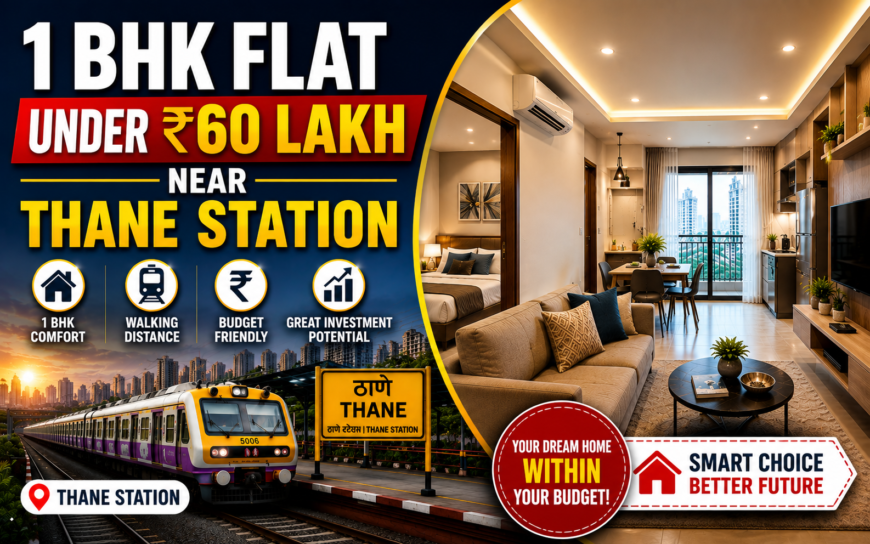
1 BHK Flat Under ₹60 Lakh Near Thane Station
Table of Contents
Sub-₹60 Lakh inventory close to Thane Station is genuinely limited — most projects in this catchment have moved well past that price point in the last few years. If you’re specifically looking for a 1 BHK flat under ₹60 Lakh near Thane Station, here’s what your budget realistically buys, and where to find it.
What Fits in This Budget Near Thane Station
At this price point, expect:
- Compact carpet areas — typically 300–400 sq.ft. for a genuine 1 BHK in this micro-market
- New launch or early-construction stage projects, since ready-to-move inventory near the station tends to price higher
- Entry-level units within a price band — often the smallest carpet-area option in a project, with larger units in the same project priced above ₹60L
That last point matters: many projects that “start under ₹60L” only have one or two unit types actually in that bracket. Always ask for the price against the specific carpet area you’re being shown, not the project’s advertised starting price.
Featured Project: Shree Ram Enclave, Mahagiri Koliwada
Shree Ram Enclave fits this search directly — its entry price is ₹59.99 Lakh, just under the ₹60L mark, for the smallest unit in the project.
| Detail | Info |
|---|---|
| Location | Mahagiri Koliwada, Jambli Naka, Thane West |
| Price Range | ₹59.99L – ₹77.20L |
| Entry Price Unit Size | 317 sq.ft. (approx.) |
| Largest Unit Size | 386 sq.ft. |
| Possession | December 2027 |
| RERA ID | PR1330002501902 |
Important: only the smallest carpet-area unit is priced at ₹59.99L. Larger units in the same project go up to ₹77.20L — so if budget is your hard constraint, confirm current availability of the entry-price unit before you visit, since these tend to sell out first in new launches.
Related reads:
- Full comparison: 1 BHK Flat Near Thane Station — Complete Buyer’s Guide
- Want it furnished? 1 BHK Fully Furnished Flat Near Thane Station
- Commute matters most? 1 BHK Flat Walking Distance from Thane Station
FAQs
What is the cheapest 1 BHK price at Shree Ram Enclave?
₹59.99 Lakh for the smallest available carpet area (approx. 317 sq.ft.).
Are all units under ₹60 Lakh?
No — prices range up to ₹77.20 Lakh depending on carpet area. Only the entry-level unit falls under ₹60L.
Is this a new launch or ready-to-move project?
New launch, with possession expected by December 2027.
Is home loan financing available?
Most RERA-registered new launches are approved for home loans by major lenders — confirm the specific bank tie-ups with the sales team.
Want to check if the ₹59.99L unit is still available?
Call +91 99992 21552 now or view the current price list — entry-price units in new launches go first.
 Real Estate
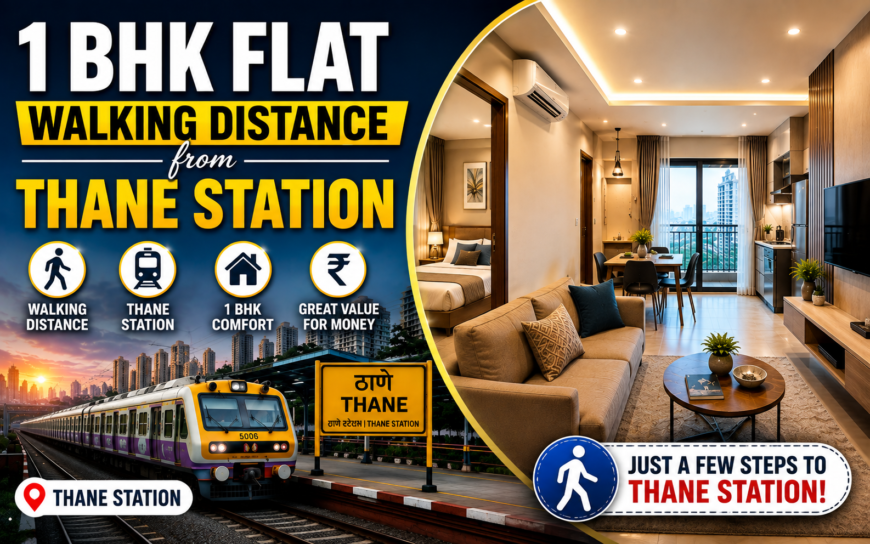
1 BHK Flat Walking Distance from Thane Station
Table of Contents
For a daily commuter, “5 minutes from the station” and “15 minutes from the station” are two completely different lifestyles. If your priority is a 1 BHK flat within walking distance of Thane Station, here’s how to evaluate that claim properly — and a project that fits the catchment.
How to Actually Verify “Walking Distance”
Real estate listings throw the phrase around loosely. Before you shortlist anything:
- Ask for the route distance in kilometres, not a vague “nearby” claim
- Check the walk on Google Maps at actual street level — some routes near stations involve narrow lanes or level crossings that add real time
- Ask about the route to the specific station entrance you’d use daily, not just “Thane Station” broadly
- Factor in the last-mile connectivity — auto stands, bus stops — for the days you won’t walk
Why Buyers Prioritize This
A flat within walking distance of the station means:
- No auto/rickshaw dependency for your daily commute
- Lower monthly transport cost, which adds up over a home loan tenure
- Higher rental demand if you ever lease it out — tenants pay a premium for zero-commute locations
- Better resale liquidity, since walk-to-station inventory is genuinely limited in Thane
Featured Project: Shree Ram Enclave, Mahagiri Koliwada
Shree Ram Enclave is located at Mahagiri Koliwada, Jambli Naka, Thane West — within the station’s immediate catchment area, with the Cidco Bus Depot Thane as its nearest public transport hub and direct connectivity to Kalwa Depot and Thane Railway Station.
| Detail | Info |
|---|---|
| Location | Mahagiri Koliwada, Jambli Naka, Thane West |
| Size | 317 – 386 sq.ft. |
| Price | ₹59.99L – ₹77.20L |
| Nearest Transit Hub | Cidco Bus Depot Thane |
| Possession | December 2027 |
| RERA ID | PR1330002501902 |
We’d recommend confirming the exact walking route and time to your preferred station entrance directly with the sales team when you visit — that’s the one number worth verifying in person rather than off a listing.
Related reads:
- Broader comparison: 1 BHK Flat Near Thane Station — Complete Buyer’s Guide
- On a budget? 1 BHK Flat Under ₹60 Lakh Near Thane Station
- Want it move-in ready? 1 BHK Fully Furnished Flat Near Thane Station
FAQs
Is Shree Ram Enclave within walking distance of Thane Station?
It’s located at Mahagiri Koliwada, Jambli Naka — in the station’s catchment area with the Cidco Bus Depot as the nearest transit hub. Confirm the exact walk time to your preferred station gate during a site visit.
What’s nearby besides the station?
Bhadkamkar Hospital is a prominent landmark close to the project.
Is this project RERA registered?
Yes, under MahaRERA No. PR1330002501902.
Planning a site visit to check the actual commute distance?
Call +91 99992 21552 to schedule one, or view details on the project page.
 Real Estate
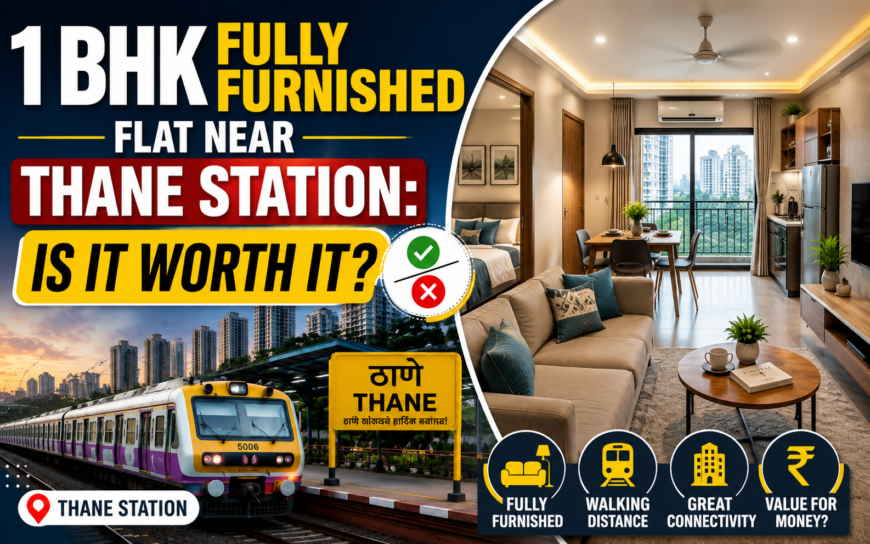
1 BHK Fully Furnished Flat Near Thane Station: Is It Worth It?
Table of Contents
Buying a bare-shell flat and furnishing it yourself sounds cheaper on paper — until you add up modular kitchens, wardrobes, false ceilings, and the 3–6 months it takes to get it all done. That’s why more buyers near Thane Station are actively searching for a 1 BHK fully furnished flat, not just a 1 BHK.
What “Fully Furnished” Should Actually Include
Before you take a builder’s word for it, get the furnishing scope in writing. At minimum, it should cover:
- Modular kitchen with basic fittings
- Wardrobes in the bedroom
- Flooring (tiles/vitrified) throughout
- Basic electrical and lighting fixtures
- Bathroom fittings and sanitaryware
Anything less is “semi-furnished” dressed up in marketing language — worth clarifying with the sales team before you factor it into your budget comparison.
Why This Matters More Near Thane Station
1 BHKs in this belt are heavily bought by working professionals who want to move straight from signing to living — no 3-month renovation gap eating into their commute-time savings. A furnished flat near the station effectively compresses your “decision to move-in” timeline, which matters if you’re relocating for work or upgrading from a rental.
Featured Project: Shree Ram Enclave, Thane West
Shree Ram Enclave at Mahagiri Koliwada, Jambli Naka is marketed as a fully furnished offering — worth a direct conversation with the sales team to confirm the exact furnishing checklist against your requirements before booking.
| Detail | Info |
|---|---|
| Location | Mahagiri Koliwada, Jambli Naka, Thane West |
| Size | 317 – 386 sq.ft. |
| Price | ₹59.99L – ₹77.20L |
| Possession | December 2027 |
| RERA ID | PR1330002501902 |
| Amenities | Car Parking, Gym, 24×7 Security, Children’s Play Area, Yoga Deck, Senior Citizen Siteout |
Given the compact carpet area (317–386 sq.ft.), a furnished 1 BHK here works especially well for singles, couples, or as a rental-ready investment property near the station.
Related reads:
- Start here: 1 BHK Flat Near Thane Station — Complete Buyer’s Guide
- Budget-focused? 1 BHK Flat Under ₹60 Lakh Near Thane Station
- Commute-focused? 1 BHK Flat Walking Distance from Thane Station
FAQs
What does “fully furnished” mean at Shree Ram Enclave?
Confirm the exact furnishing checklist directly with the sales team — this varies by project and should be documented before booking.
Is a furnished flat more expensive than an unfurnished one?
Usually the price difference is smaller than what you’d spend furnishing it independently, once you factor in time, GST on separate purchases, and vendor coordination.
What is the carpet area range at Shree Ram Enclave?
317 to 386 sq.ft. across the available 1 BHK units.
Want the exact furnishing specification sheet for Shree Ram Enclave?
Call +91 99992 21552 or check the project page for the current price list.
 Real Estate
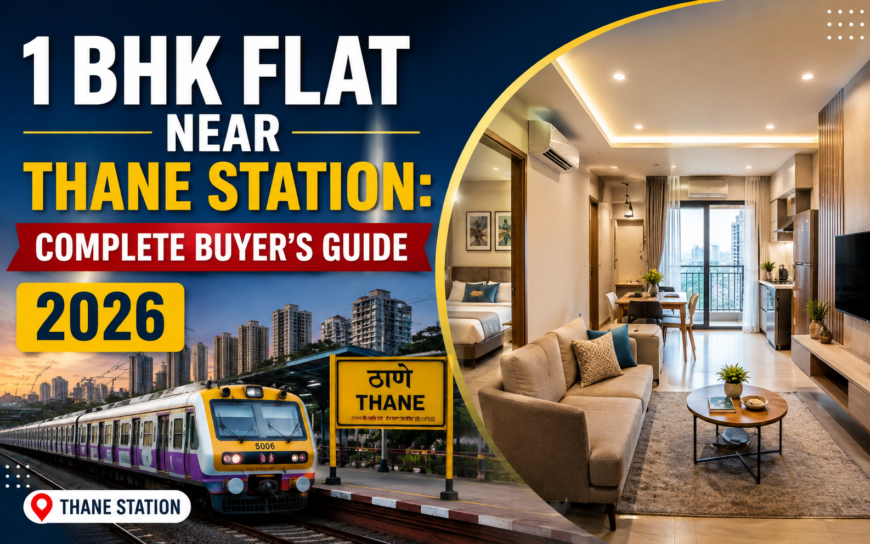
1 BHK Flat Near Thane Station: Complete Buyer’s Guide (2026)
Table of Contents
Thane Station isn’t just a railway stop — for thousands of Mumbai-bound commuters, it’s the reason they choose to live in Thane at all. If you’re hunting for a 1 BHK flat near Thane Station, you’re chasing the same thing everyone else is: a short commute, strong resale value, and a neighbourhood that already has everything — hospitals, schools, markets — within reach.
Here’s what actually matters when you’re comparing options, and where to look right now.
Why Buy a 1 BHK Near Thane Station
Connectivity first. Thane Station sits on the Central Line, giving you direct access to CSMT, Kalyan, and the entire suburban network. Add the Cidco Bus Depot and Kalwa Depot into the mix, and you’re covered for both rail and road commutes without needing a personal vehicle.
Investment logic. Properties within a 2–3 km radius of Thane Station have historically held their value better than peripheral Thane localities, simply because rental and resale demand never really dries up — students, young professionals, and small families all want to be near the station.
Everyday convenience. Established localities near the station — Jambli Naka, Naupada, Panchpakhadi, Mahagiri Koliwada — already have hospitals, schools, and markets built out. You’re not waiting years for the neighbourhood to “develop.”
What to Check Before You Buy
- RERA registration — always verify the project on maharera.maharashtra.gov.in before booking.
- Actual distance to station — “near Thane Station” gets used loosely. Ask for the exact route distance, not straight-line distance.
- Possession timeline — new launches vs. ready-to-move have very different cash flow implications.
- Carpet area, not built-up area — this is where most 1 BHK buyers get misled on price-per-sq-ft comparisons.
Featured Project: Shree Ram Enclave, Mahagiri Koliwada
If you’re specifically looking in the Thane Station catchment, Shree Ram Enclave, Thane West is worth shortlisting.
| Detail | Info |
|---|---|
| Location | Mahagiri Koliwada, Jambli Naka, Thane West |
| Configuration | 1 BHK |
| Size | 317 – 386 sq.ft. |
| Price | ₹59.99L – ₹77.20L |
| Possession | December 2027 (New Launch) |
| RERA ID | PR1330002501902 |
| Nearby Landmark | Bhadkamkar Hospital |
| Connectivity | Cidco Bus Depot Thane, Kalwa Depot, Thane Railway Station |
It’s a RERA-registered project by Shree Ram Buildcon Mumbai, developed on a 0.24-acre plot with a single G+7 tower — car parking, gym, 24×7 security, children’s play area, and a senior citizen siteout among the amenities.
Depending on what matters most to you, you may also want to see it from a different angle:
- Buying on a tighter budget? Read: 1 BHK Flat Under ₹60 Lakh Near Thane Station
- Want to skip the fit-out cost? Read: 1 BHK Fully Furnished Flat Near Thane Station
- Commute is your #1 priority? Read: 1 BHK Flat Walking Distance from Thane Station
FAQs
Is Shree Ram Enclave RERA registered?
Yes. It’s registered under MahaRERA No. PR1330002501902, verifiable on the official MahaRERA website.
What is the price range for a 1 BHK at Shree Ram Enclave?
Units are priced between ₹59.99 Lakh and ₹77.20 Lakh, depending on carpet area (317–386 sq.ft.).
When is possession expected?
The project is in the new launch phase, with possession expected by December 2027.
How far is the project from Thane Railway Station?
It’s located at Mahagiri Koliwada, Jambli Naka — within the Thane Railway Station catchment, close to the Cidco Bus Depot.
Interested in Shree Ram Enclave or similar 1 BHK options near Thane Station? Call +91 99992 21552 or enquire on the project page for the latest price list and floor plans.
 Real Estate
What Makes a Commercial Tower “Premium” in Thane? Biophilic Design & IGBC Gold, Explained
Table of Contents
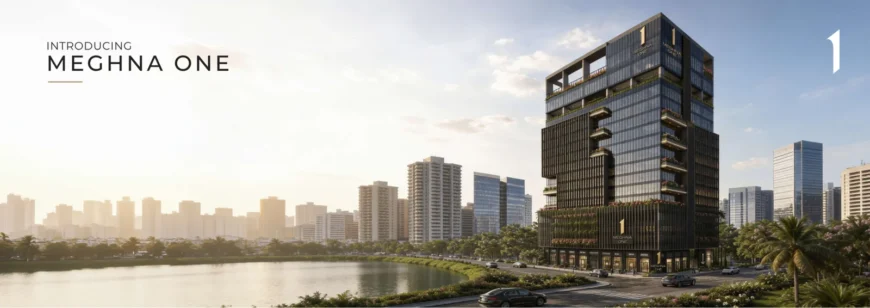
“Premium” gets used loosely in commercial real estate marketing — often meaning little more than a higher price tag and a marble lobby. For buyers comparing options across Mumbai, Thane, and Pune, it’s worth understanding what genuinely separates a premium commercial address from a standard one. Meghna One Wagle Estate is a useful case study, since it’s built around two specific, measurable standards rather than just aesthetic finishes. (For the fuller picture on the project, see our benefits and drawbacks breakdown.)
What IGBC Certification Actually Measures
The Indian Green Building Council (IGBC) rates buildings on energy efficiency, water conservation, waste management, and indoor environmental quality, across tiers from Certified up to Platinum. Gold — the level Meghna One is targeting — sits in the upper half of that scale. This isn’t a decorative label; it reflects measurable choices in building systems, materials, and design that affect actual running costs and occupant comfort over the building’s lifetime.
For a buyer comparing “premium” claims across different projects, asking whether a green rating is actually certified (versus just described as “eco-friendly” in marketing copy) is one of the more reliable ways to separate genuine premium positioning from surface-level branding.
Biophilic Design: The Difference Between a “Nice Lobby” and Genuine Design Quality
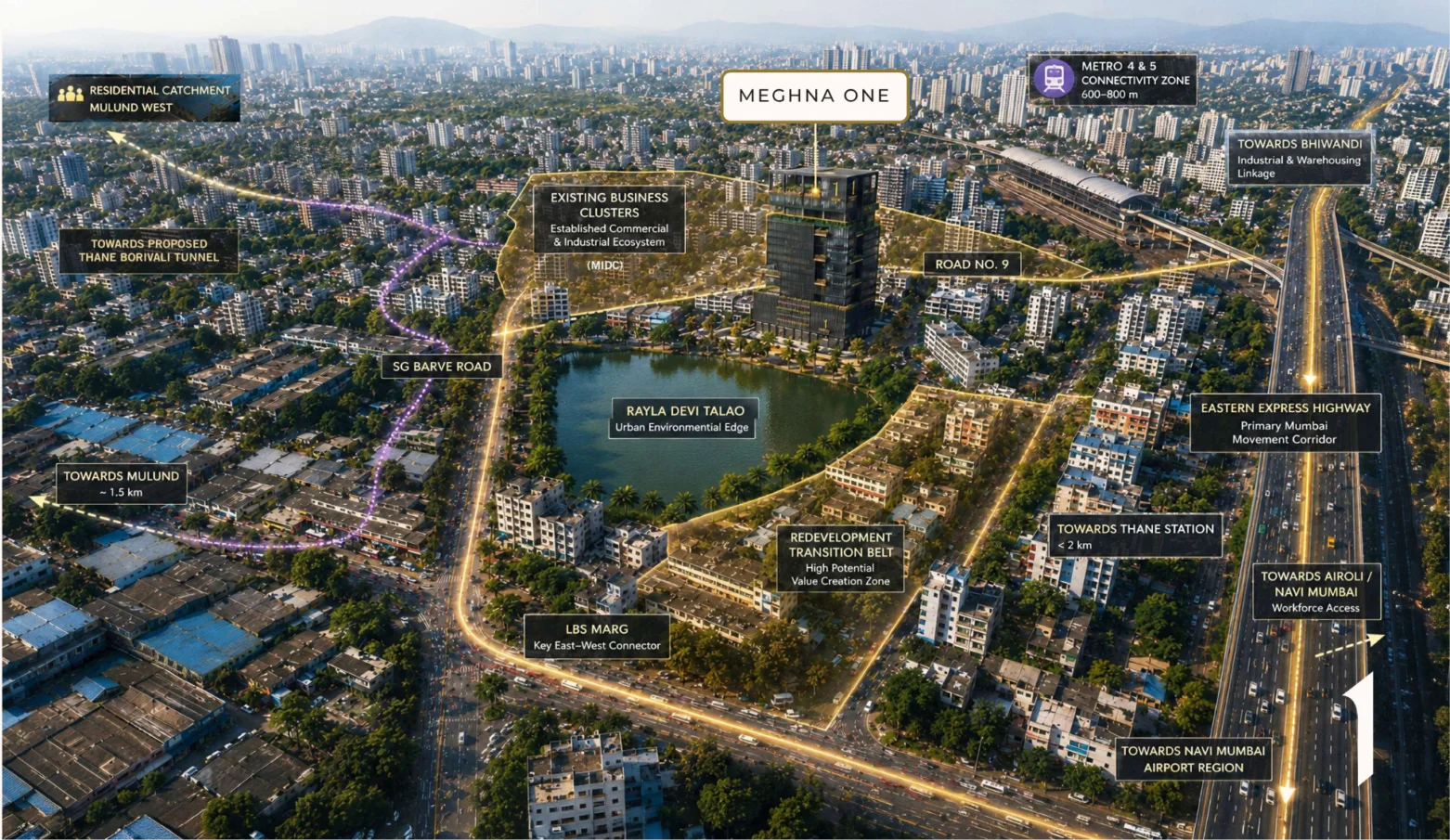
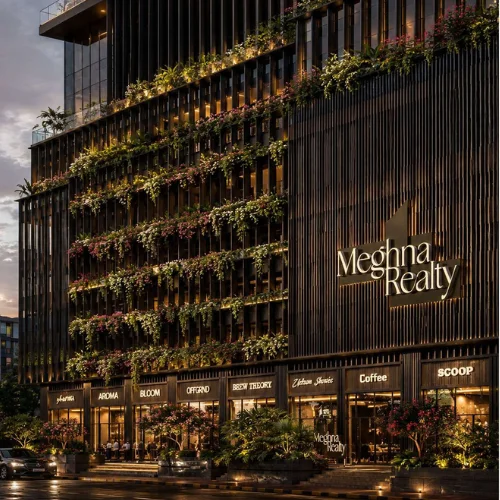
Biophilic design refers to architecture built around natural light, greenery, and outdoor connection — not as decoration, but as a structural design choice. In Meghna One’s case, this includes landscaped green terraces, pillar-less floor plates that let daylight reach deeper into each floor, and a layout oriented around its lake-facing aspect.
This is a meaningfully different design approach from a conventional commercial tower with a nice entrance but standard deep, artificially-lit floor plates behind it. The difference shows up daily, not just on move-in day — natural light and greenery exposure are consistently linked to better focus and lower stress for people working in the space.
Why “Lake-Facing” Adds a Layer Most Buildings Can’t Replicate
A green certification and thoughtful floor plate design can, in principle, be replicated by any developer willing to invest in it. A lake-facing orientation cannot — it depends entirely on the land parcel itself. This is part of why Meghna One’s positioning as Wagle Estate’s first lake-facing tower is a genuine differentiator rather than a marketing flourish: no amount of budget from a competing project on a different plot can add a lake view that doesn’t exist for that land.
How to Evaluate “Premium” Claims on Any Project
When you’re comparing commercial options — in Thane or elsewhere — a few direct questions cut through marketing language quickly:
- Is there an actual, verifiable green building certification (and at what tier), or just descriptive language?
- Does the floor plate design genuinely bring in natural light, or is “premium” limited to the lobby and facade?
- Is there a structural site feature (like water frontage or a park-facing orientation) that can’t be replicated by a competing project, or is the premium tag based purely on finishes and pricing?
Where Meghna One Fits
Applying that lens, Meghna One’s premium positioning holds up reasonably well — IGBC Gold is a verifiable, tiered certification rather than a marketing description, the biophilic elements (green terraces, pillar-less layouts) affect the actual floor plate design rather than just common areas, and the lake-facing aspect is a genuine site-specific feature. Combined with Wagle Estate’s established commercial base and connectivity, it’s a credible use of the “premium” label rather than a purely price-driven one.
Conclusion
“Premium” is worth interrogating rather than taking at face value on any commercial listing. Meghna One’s case for the label rests on specific, checkable factors — a real green certification, genuine daylighting-focused design, and a site feature no competing plot can copy — which is a more substantive basis than most projects claiming the same positioning purely on price point.
Want to see the lake-facing units and floor plans in person? Call or WhatsApp us at +91 99992 21552 to schedule a site visit.
 Real Estate
A First-Time Commercial Buyer’s Checklist for Meghna One Wagle Estate
Table of Contents
Buying your first commercial property is a different process from a residential purchase — different documents, different financing, different questions to ask. If Meghna One Wagle Estate is on your shortlist, here’s a practical checklist to work through before you book. (For a broader look at the project’s overall benefits and drawbacks, see our detailed breakdown.)
Before You Book: Verification Checklist
☐ Confirm MahaRERA registration directly on the portal. Meghna One’s registration number is PC1330002601099 — look it up yourself on maharera.maharashtra.gov.in rather than relying on a broker’s word. The portal shows registered land area, promised possession date, and any filed complaints.
☐ Confirm carpet area, not super built-up area. Since RERA, developers must quote carpet area — the actual usable space within your unit’s walls. Make sure any price-per-sq.ft. comparison you’re doing against other projects uses the same basis; mixing carpet area with super built-up area can distort your comparison by 25–30%.
☐ Ask for the current construction stage and, if construction has started, visit the site in person rather than relying on renders alone.
☐ Get the full payment schedule in writing and confirm whether installments are tied to construction milestones or a fixed calendar.
☐ Clarify what’s included and excluded — parking allocation, maintenance/society charges, floor-rise charges, and any preferential location charges for lake-facing or corner units.
☐ Ask about the developer’s delivery track record on previously completed projects, independent of this specific tower’s own merits.
Documents You’ll Typically Need
☐ PAN card and Aadhaar (or equivalent KYC documents) ☐ Proof of income / business financials (especially important if buying through a company or LLP, since eligibility is assessed differently than for individual home loans) ☐ Bank statements for the past 6–12 months ☐ If financing through a loan: pre-approval or in-principle sanction letter
Financing Considerations
Commercial property loans differ from residential ones — expect a lower loan-to-value ratio (often 60–70% versus 80–90% for a home loan) and typically higher interest rates. Start the financing conversation with your bank or NBFC early, since commercial loan eligibility depends heavily on business financials if you’re purchasing through a business entity.
Tax and Cost Considerations
☐ GST — currently 12% on under-construction commercial property, with input tax credit implications depending on your business structure ☐ Stamp duty and registration charges — standard Maharashtra rates apply on top of the base price ☐ Factor both into your total budget upfront, not as a late surprise at agreement signing
Questions Worth Asking Directly
- What happens if possession is delayed beyond the RERA-registered date?
- Is the quoted price locked, or subject to escalation clauses tied to construction stage?
- What’s the maintenance/society structure planned post-possession?
- Are there specific units (e.g., lake-facing) at a premium over the base rate?
Conclusion
None of this is complicated, but skipping any one of these steps is where first-time commercial buyers most often run into avoidable surprises later. The RERA verification and the carpet-area confirmation are the two most important items on this list — everything else follows more easily once those are locked down.
Have questions about your specific situation, or want the current price list and floor plans? Call or WhatsApp us at +91 99992 21552 — we’re happy to walk first-time buyers through the process.
 Real Estate
Connectivity Snapshot : Getting To and From Meghna One Wagle Estate
Table of Contents
A quick-reference look at how Meghna One Wagle Estate connects to the rest of the region — useful if you’re comparing this location against other commercial addresses across Mumbai, Thane, or Pune.
Location
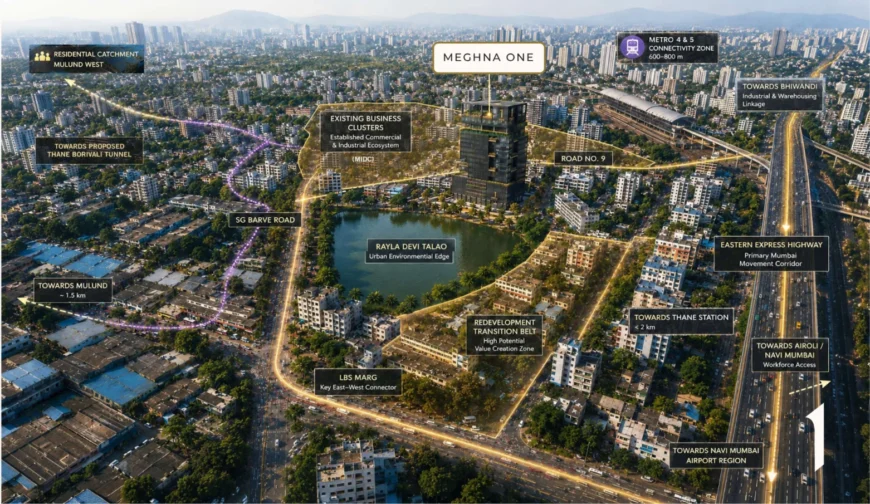
Road No. 9, opposite Odyssey IT Park, at the entrance of Wagle Estate, Thane West.
By Road
- Eastern Express Highway — direct access, the primary route toward Mumbai’s eastern suburbs and South Mumbai
- LBS Marg — alternate route toward Thane Railway Station and Mulund
- Ghodbunder Road — connects from Thane’s newer residential belts (Manpada, Hiranandani Estate, and further north)
By Rail
- Thane Railway Station — approximately 3–4 km away, roughly a 10–15 minute drive depending on traffic. Thane is a major Central Line junction, making this a genuinely commutable location for staff traveling via suburban rail from across Mumbai and Thane district.
By Metro (Upcoming)
- Mumbai Metro Line 4 (Wadala–Kasarvadavali) is under construction, with a planned station near Wagle Estate/Cadbury Junction. Once operational, this adds direct metro access to the location — a genuine future upgrade, though metro project timelines in the MMR region have historically seen delays, so treat this as a medium-term positive rather than an immediate one.
By Air
- Mumbai’s airports (domestic and international) are roughly 25–30 km away, typically 45–70 minutes by road depending on time of day and traffic — comparable to most Thane commercial addresses.
Quick Comparison Points
| Mode | Distance/Access | Status |
|---|---|---|
| Eastern Express Highway | Direct access | Operational |
| Thane Railway Station | ~3–4 km | Operational |
| Metro Line 4 (Wagle Estate/Cadbury Junction) | Nearby | Under construction |
| Airport (Mumbai) | ~25–30 km | Operational |
Conclusion
Meghna One’s connectivity is solid today via road and rail, with a genuine upside once Metro Line 4 becomes operational. For buyers weighing this against options elsewhere in Mumbai, Thane, or Pune, the entrance-of-estate positioning keeps commute times to the main arterial roads shorter than deeper pockets of Wagle Estate.
For a fuller look at what else the project offers, see our benefits and drawbacks breakdown.
Want directions from your specific location or a site visit scheduled? Call or WhatsApp us at +91 99992 21552.
 Real Estate
Meghna One Wagle Estate: Benefits, Drawbacks and What Buyers Should Know
Table of Contents
For buyers comparing commercial property options across Mumbai, Thane, Meghna One Wagle Estate is one of the newer names worth knowing. Here’s a straightforward look at what it offers and what to check before deciding.
Project Overview
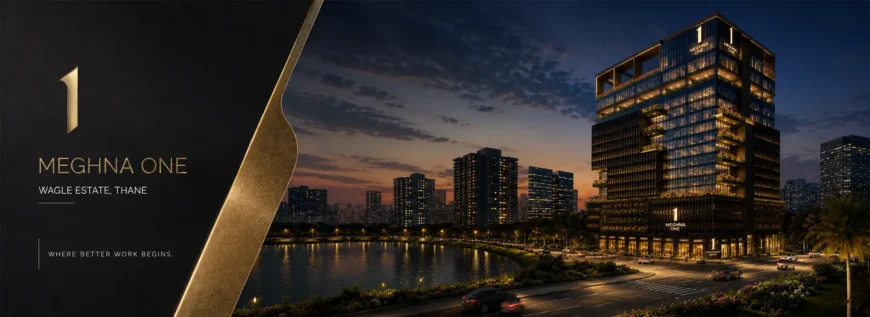
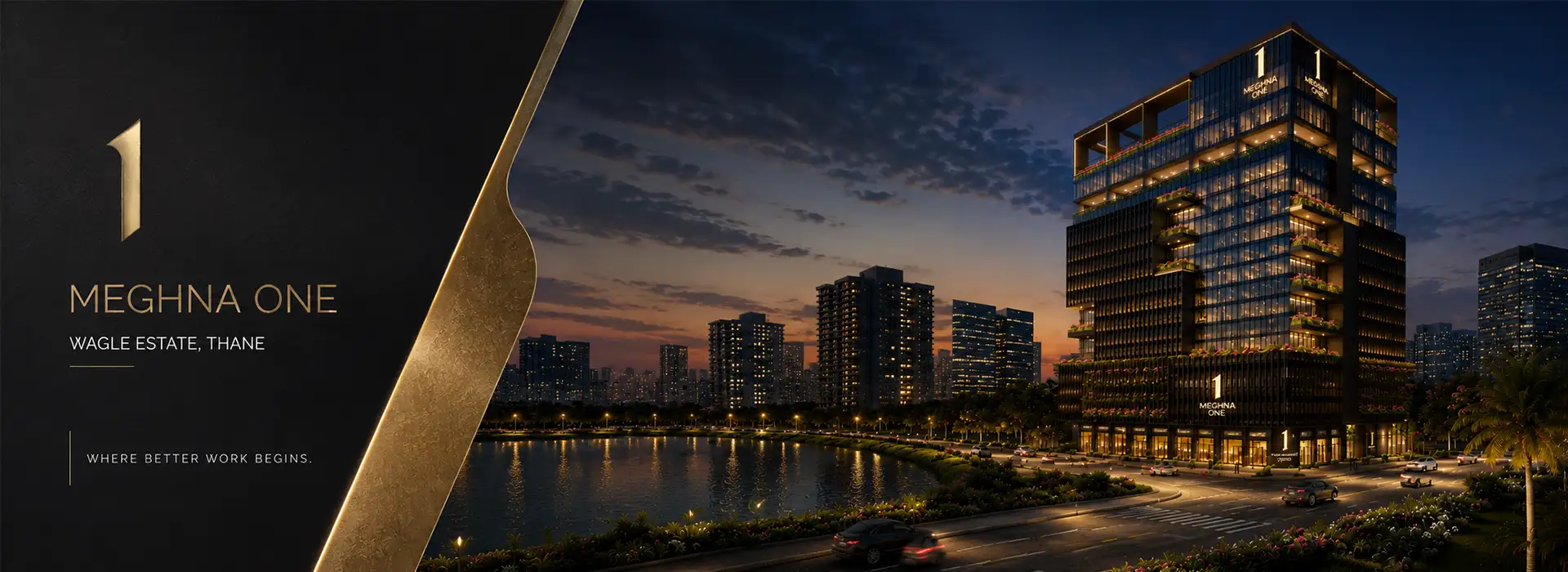
Meghna One is an 18-storey commercial tower by Meghna Realty, located at Road No. 9, at the entrance of Wagle Estate, Thane West — opposite Odyssey IT Park. The tower is planned with ground-floor retail, podium parking across the 1st to 5th floors, commercial office space on the 6th to 16th floors, a recreation deck on the 17th floor, and premium restaurant spaces on the 18th. Office units range from approximately 600 sq.ft. to 2,000+ sq.ft. The project is registered under MahaRERA (PC1330002601099), with possession tentatively planned for December 2029.
Benefits
A well-established commercial address. Wagle Estate is one of Thane’s longest-running commercial and industrial belts, with a large existing base of businesses already operating in the area. That gives Meghna One a proven demand environment to launch into, rather than an unproven new pocket.
Strong road and rail access. The location connects to the Eastern Express Highway and sits within a reasonable distance of Thane Railway Station, with Mumbai Metro Line 4 planned nearby — a meaningful future upgrade for the belt’s connectivity.
IGBC Gold-certified, biophilic, lake-facing design. This is the project’s clearest point of difference. Meghna One is being positioned as Thane’s first lake-facing, IGBC Gold-certified biophilic commercial tower — landscaped terraces, natural light, pillar-less layouts — a combination that’s uncommon among Wagle Estate’s existing and upcoming commercial supply.
Flexible unit sizes. With options from 600 sq.ft. to 2,000+ sq.ft., the project accommodates independent professionals, small teams, and larger occupiers within the same building.
Amenities beyond the norm for commercial towers. A rooftop clubhouse, swimming pool, padel court, and gym are more typical of premium residential projects than commercial ones, adding a lifestyle dimension that’s uncommon at this end of the market.
Drawbacks
Multi-year possession timeline. December 2029 is more than three years out from launch. This is standard for a new commercial launch, but buyers should treat it as a genuine long-term commitment rather than assuming an earlier completion.
Pricing not yet public. At this stage, per-sq.ft. rates are available on request rather than published — normal for pre-launch, but it means direct self-serve comparison against other listings takes an extra step.
Standard new-launch execution risk. As with any under-construction project, delivery timelines depend on the developer’s execution. It’s reasonable to ask about track record on previously completed projects before booking.
What Buyers Comparing Across Cities Should Know
If you’re evaluating commercial options across Mumbai, Thane, and Pune, Meghna One’s positioning is closer to a mid-to-premium Thane commercial address rather than a Mumbai-core price point — which is typical for the geography, but worth keeping in mind when comparing per-sq.ft. rates across cities where land costs and micro-market maturity differ significantly.
Conclusion
Meghna One brings a genuinely differentiated design story to a well-established commercial belt, balanced against the standard risks of any pre-launch purchase — timeline and unconfirmed final pricing. Buyers comfortable with a multi-year horizon and interested in a project with real sustainability credentials will find this one worth serious consideration.
Want the latest price sheet or to schedule a site visit? Call or WhatsApp us at +91 99992 21552.
 Real Estate
How to Save Tax When Buying Property in India 2026
Table of Contents
Buying a property is one of the biggest financial decisions for most families in India. Along with the property price, buyers also need to consider additional costs such as stamp duty, registration charges, and taxes. However, the Indian government has introduced several policies and tax benefits that help homebuyers reduce their financial burden.
With the implementation of major reforms such as the Real Estate Regulation Act (RERA) and the Goods and Services Tax (GST), the property buying process in India has become more transparent and streamlined. These reforms not only protect buyers but also offer several opportunities to save taxes when purchasing a property.
If you are planning to buy a home, understanding these tax benefits can help you significantly reduce the overall cost. In this guide by Urvik Consulting, we explain the taxes involved in property purchases and the smart ways to save money.
Taxes You Pay When Buying Property in India
The taxes applicable to property purchases in India depend largely on the type of property you are buying. Generally, the taxes differ between under-construction properties and ready-to-move-in homes.
1. Taxes on Under-Construction Property
When purchasing an under-construction property, buyers are required to pay several taxes and charges, including:
- GST (Goods and Services Tax)
- Stamp Duty
- Registration Charges
GST is applicable only to under-construction properties because they are considered a service provided by the developer. Currently, the GST rate varies depending on the category of housing but is typically lower than earlier tax structures.
Stamp duty is a state government tax that legalizes the property transaction, while registration charges are required to officially record the property ownership with the government.
These charges can vary from state to state but generally range between 5% to 7% of the property value.
2. Taxes on Ready-to-Move-In Property
Ready-to-move-in properties are more tax-efficient because GST does not apply to them. Buyers only need to pay:
- Stamp duty
- Registration charges
This makes ready properties an attractive option for many buyers as they can avoid GST charges that apply to under-construction homes.
Smart Ways to Save Tax When Buying Property
While buying a home involves several costs, the Indian tax system provides multiple deductions that help buyers reduce their taxable income. Here are some of the most effective ways to save taxes when purchasing a property.
1. Tax Benefits Under Affordable Housing Schemes
The Government of India has introduced several initiatives to encourage homeownership, especially under the affordable housing segment.
Schemes like Pradhan Mantri Awas Yojana (PMAY) provide financial assistance and tax benefits to eligible homebuyers under different income categories such as:
- Economically Weaker Section (EWS)
- Lower Income Group (LIG)
- Middle Income Group I (MIG-I)
- Middle Income Group II (MIG-II)
Under these schemes, buyers may receive interest subsidies and reduced GST rates on eligible properties, making homeownership more affordable.
2. Tax Deduction on Stamp Duty and Registration Charges
Property buyers can claim tax deductions on stamp duty and registration charges under Section 80C of the Income Tax Act, 1961.
Under this section, buyers can claim deductions of up to ₹1.5 lakh for these expenses. However, this deduction is available only in the financial year in which the property purchase takes place.
This benefit can significantly reduce the taxable income of a property buyer.
3. Tax Deduction on Home Loan Interest
Home loan borrowers can claim tax deductions on the interest paid on their loan.
Under Section 24 of the Income Tax Act, buyers can claim a deduction of up to ₹2 lakh per year on interest paid for a self-occupied property.
This benefit helps reduce the effective cost of borrowing and makes home loans more manageable for buyers.
4. Tax Benefits on Joint Home Loans
Another effective way to maximize tax benefits is by taking a joint home loan with a spouse or family member.
In a joint loan, both co-borrowers can claim tax benefits individually if they are also co-owners of the property.
Each borrower can claim:
- Up to ₹2 lakh deduction on interest under Section 24
- Up to ₹1.5 lakh deduction on principal repayment under Section 80C
This strategy can significantly increase the total tax savings for a family purchasing a home together.
5. Tax Deduction on Principal Repayment
Homebuyers can also claim tax deductions on the principal repayment of their home loan.
Under Section 80C, buyers can claim a deduction of up to ₹1.5 lakh per year on the principal component of their EMI payments.
However, there is an important condition. The property must not be sold within five years of possession. If the property is sold before this period, the claimed deductions may be added back to the taxable income.
Why Understanding Tax Benefits Matters
Many homebuyers focus only on the property price and overlook the tax benefits available to them. By understanding these deductions and incentives, buyers can significantly reduce their overall financial burden.
At Urvik Consulting, we help property buyers make informed decisions by guiding them through the entire property purchase process from selecting the right property to understanding financial and tax advantages.
Final Thoughts
Buying a property in India involves several taxes and charges, but the government also provides multiple tax benefits to support homebuyers. From deductions on home loan interest and principal repayment to benefits under affordable housing schemes, these incentives can substantially lower the cost of owning a home.
If you are planning to purchase property in India, understanding these tax benefits can help you make smarter financial decisions and maximize your savings.
For expert guidance on buying the right property and understanding the financial aspects of homeownership, connect with Urvik Consulting today.